
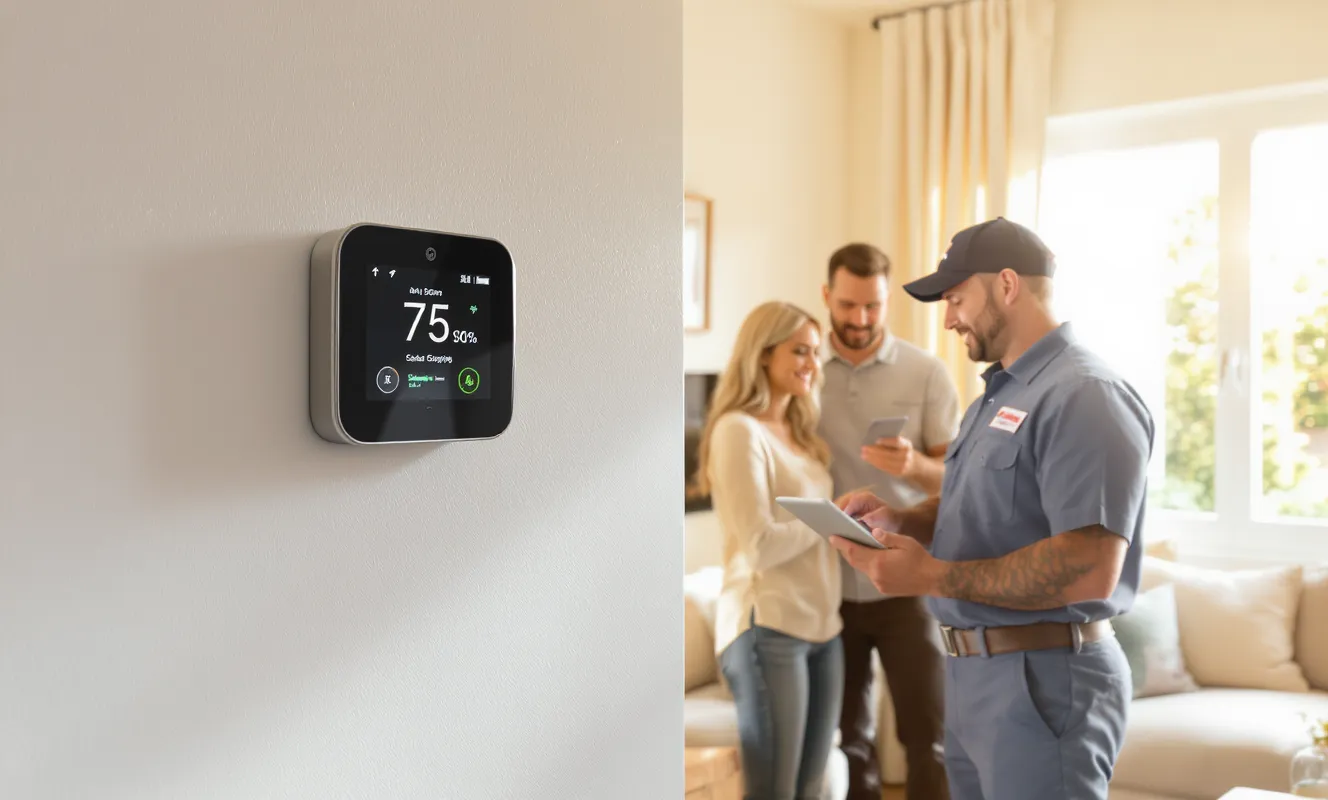
Every Austin household has the fight. One person's 72 is another's parka weather; somebody's dad set it at 78 in 1994 and never forgave anyone; and the utility bill arrives each September like a referee's scorecard. So let's settle it honestly: there is a defensible answer to the best AC temperature for Austin summers, it's a range rather than a number, and the interesting part isn't the setpoint — it's the strategy around it. Here's what the energy math, the sleep science, and twenty years of Central Texas HVAC experience actually say.
The famous efficiency guidance — 78°F when home, higher when away — was written by people optimizing grids, not marriages. The real-world Austin distribution: most households live between 72 and 76 when home, and the honest engineering answer is the warmest setting your household genuinely stops noticing, because the cost curve is relentless: every degree below 78 adds roughly 3–5% to cooling costs. Across an Austin summer, where cooling dominates the bill from May through September, the gap between a 72 house and a 76 house is commonly hundreds of dollars — real money for a difference that fans, humidity control, and smart scheduling can mostly erase. The move isn't suffering at 78; it's engineering 76 to feel like 73.
Ceiling fans, used correctly, are worth 2–3 degrees. Counterclockwise in summer, medium-high, and — the part everyone skips — off in empty rooms, because fans cool skin, not air. A house that feels right at 73 with still air typically feels the same at 75–76 with moving air, and the fan costs pennies to the compressor's dollars.
Humidity is half of comfort. Austin's muggy stretches make 75 feel like a swamp; dry spells make 78 feel fine. A system that's healthy and correctly sized dehumidifies as it cools — which is why oversized systems (cool fast, shut off before drying the air) leave houses cold and clammy, the worst of both. If sticky-at-every-setting describes your summer, that's a diagnosable airflow/sizing/charge issue, not a thermostat problem.
Fight the sun, not just the heat. West-facing glass is Austin's great afternoon tax. Blinds or solar screens closed by noon on west exposures buy back 1–2 degrees of afternoon comfort for free — and take direct load off the exact hours your system struggles most.
That's usually diagnosable — weak charge, dirty coils, duct losses. Beaver matches Austin homeowners with a licensed, vetted AC pro, price quoted before any work.
The most expensive myth in Austin HVAC: "leave it at one temperature — it works harder to catch up than it saves." It doesn't. Heat flows into your house proportionally to the indoor-outdoor gap; a warmer house all afternoon absorbs less heat, and the recovery run costs less than the avoided runtime saved. The practical Austin playbook: set back 7–10 degrees when away in normal weather; trim that to 4–6 degrees during 100°+ stretches so recovery doesn't stretch past your arrival (and so afternoon peak-price hours aren't spent in max recovery). A smart thermostat automates the whole dance — including the pre-cool that starts before you're home — and it's the rare gadget whose payback in an Austin climate is measured in months.
Sleep science wants you slightly cool — the oft-cited 68–72 zone — and August wants your money. The workable compromise most Austin households land on: 74–76 overnight with bedroom ceiling fans, which reads on skin like the low 70s. Two upgrades: program a pre-cool an hour before bedtime (crashing the setpoint at 10pm forces the system into its least efficient sprint during the evening's still-hot hours), and let the schedule drift the temperature up in the final pre-dawn hours, when outdoor lows do some of the work free. If one bedroom never cools like the others, that's ducts or dampers — a diagnosis, not a thermostat war.
Errands-length absences: let the setback do its work. Vacations: 80–83, never off. A sealed Austin house with the AC off in July can push interior temperatures into ranges that stress drywall, electronics, pets' safety margins, and — the quiet one — humidity, since a non-running system dehumidifies nothing while the house bakes and breathes. Eighty-ish keeps the humidity managed and the recovery civilized for a fraction of occupied-cost, and a smart thermostat lets you start the pre-cool from the airport.
On genuine scorchers — 103° and up — a healthy residential system holding a 20–25 degree indoor-outdoor gap while running nearly continuously is performing to design, not failing. The diagnostic signal isn't absolute temperature; it's change. A house that held 74 through last August but can't reach 77 this one has lost capacity somewhere — charge, coils, blower, or duct leakage — and that decline is cheapest to fix at the "annoying" stage. The escalation path: our warm-air troubleshooting guide for the free checks, the 2026 repair cost guide for what fixes run, and a shoulder-season tune-up as the standing prevention that keeps the afternoon gap from growing in the first place.
One equipment note that reframes the whole argument: variable-speed systems — increasingly the standard in 2026 replacements — change the game by running long, low, quiet cycles that hold temperature within a fraction of a degree while wringing out humidity continuously. Households that upgrade routinely discover they're comfortable two degrees warmer than their old setpoint, which is the rare HVAC purchase that wins the thermostat fight by dissolving it.
Central Texas summers now come with conservation-appeal days, when ERCOT asks everyone to ease off during late-afternoon peak. The thermostat strategy above already handles this gracefully: pre-cool the house 2–3 degrees in the early afternoon while supply is comfortable, then ride the 3–7pm window a couple of degrees higher on the thermal mass you banked. A well-insulated house coasts through the peak barely noticing; a leaky one makes the case for the weatherization you've been postponing. If you're on a time-of-use electric plan, this same maneuver is a monthly bill strategy, not just a civic one — cooling is cheapest to bank exactly when the grid wants you to bank it.
A candid list, because thermostat guides love to overpromise. No setpoint strategy fixes leaky attic ducts (you're air-conditioning the attic), a clogged filter (airflow is the ballgame), an oversized system's clammy short-cycling, or the west-room-that's-always-hot (that's load, shading, or duct balance). Strategy stacks on top of a healthy system; it doesn't substitute for one. The good news is that every one of those problems announces itself through the patterns this guide describes — sticky comfort, growing afternoon gaps, one stubborn room — and each is a routine, priceable fix in the 2026 cost guide rather than a mystery. Tune the machine, then tune the schedule; in that order, the results compound.
The last word on the household fight: the thermostat number was never really the argument. Comfort is temperature plus humidity plus airflow plus expectation — and a well-maintained system in a sun-managed house makes 76 feel like the 72 everyone was fighting for, at a fraction of the September bill. Set the range, automate the schedule, and spend the savings at the barbecue line like a proper Austinite.