
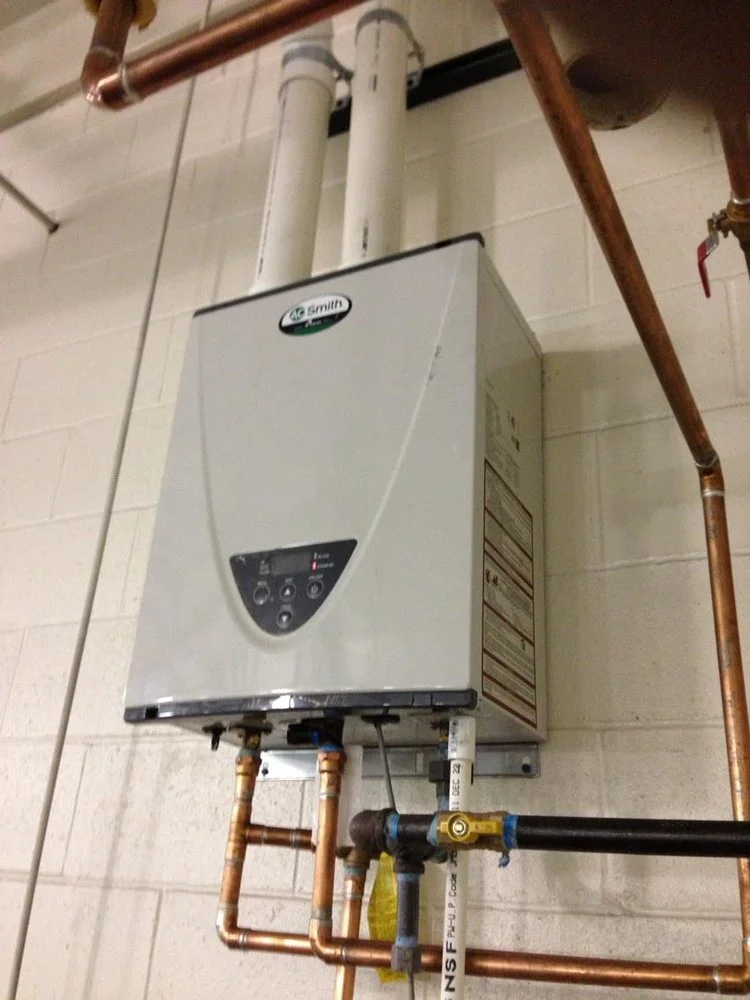
The most persistent myth in Austin plumbing is that a tankless water heater "pays for itself." Sometimes it does — over a long enough horizon, with the right gas service, in the right house. But the version of the pitch that skips the gas-line upgrade, the venting, and the annual descaling our 180-something-ppm water demands isn't a forecast; it's a brochure. Here's the comparison the brochure leaves out, with 2026 numbers attached.
A standard 40–50 gallon gas tank, installed and up to code, runs $1,300–$2,600 in the Austin area — the spread is mostly location (garage floor vs. attic platform) and how much code catch-up the old install owes: expansion tank, pan and drain, seismic straps, T&P discharge. A gas tankless unit lands at $2,000–$3,500 for a straightforward swap where gas and venting cooperate, and $3,500–$6,500 when they don't — which in Austin's 1970s–'90s housing stock is often. The culprit is fuel: a tankless burner draws 150,000–199,000 BTU against a tank's 40,000, and the half-inch gas line feeding the old tank can't deliver it. The line upsizing runs $500–$1,000 by itself. Electric tankless ($1,400–$3,000) dodges the gas problem and creates an electrical one — many Austin panels can't spare the 100+ amps without an upgrade nobody budgeted.
Operating costs favor tankless — no standby losses reheating 50 gallons all night — but the honest figure is $8–$15 a month saved for a typical household, not the transformative number the marketing implies. Compound it over a decade and you've recovered maybe $1,200–$1,800 of the premium. The stronger tankless argument is lifespan: 20+ years against a tank's 8–12 in Austin water, which means one tankless install spans two tank replacements. Run that math instead and the premium starts looking like prepayment rather than splurge.
Austin water runs hard, and hardness is the variable that punishes both technologies differently. In a tank, minerals settle and bake into sediment — the popping, rumbling layer that insulates the burner from the water and shaves years off the 8–12. In a tankless, scale coats the heat exchanger's narrow passages, and the unit doesn't quietly degrade — it throws error codes and quits until descaled. That service is $150–$250 annually here (skippable only in the sense that oil changes are skippable), and it's the line item tankless quotes most reliably omit. A water softener changes the equation for both: tanks live longer, tankless descaling stretches toward every two or three years, and the combined install starts to justify itself in appliances protected.
A distinctly Austin subplot: thousands of local homes keep the water heater in the attic, where builders put it to save garage space. A tank up there is 400–500 pounds of hot water sitting above your drywall, aging toward the leak that finds the ceiling fan. Tankless units hang on a wall, hold about a coffee cup of water, and remove that particular 2 a.m. scenario entirely — for attic installs specifically, that risk transfer is worth real money beyond any efficiency math. (The emergency pan and its drain line are the tank's defense; ask when yours was last actually tested.)
Sizing is the whole game — gas line, vent path, GPM demand. Beaver matches Austin homeowners with a licensed, vetted plumber who quotes both options in one visit, free.
Tankless delivers endless hot water — but rationed, not unlimited. A unit is rated in gallons per minute, and an Austin winter (groundwater dipping toward the 50s) drops effective output right when demand peaks. Undersize the unit and two simultaneous showers become one lukewarm compromise; that's an installer error, not a technology flaw, and it's why the sizing visit matters more than the brand. Tanks fail in the mirror-image way: nothing rations the first 50 gallons, and nothing extends them — teenager number two learns this daily.
Condensing gas tankless units qualify for the federal 25C credit — 30% of cost up to $600 — and local utility rebates come and go by season, so have your installer run the current stack rather than trusting a two-year-old blog post (including this one; programs are perishable). The credit meaningfully narrows the tankless premium when it applies, and it never applies to a standard tank.
Whichever way you'll go, the timing question comes first, and tanks announce retirement in a readable sequence. Rumbling or popping is sediment boiling water underneath itself — annoying at first, then efficiency-killing. Rust-tinted hot water (hot side only — run both taps to compare) means the anode rod is spent and the tank wall is next on the menu. Moisture or crust at the base fittings is the early-leak tell, and an actual damp pan is the two-minute warning. Age past ten years in Austin water means every additional season is borrowed. None of these repairs back to health — anode swaps buy time early, but a rusting tank is a countdown, and the homeowners who choose their replacement calmly are the ones who started quoting at the first rust, not the first flood.
Run one Austin household through both columns. Tank route: install at $1,900 (mid-range), replace once around year ten for $2,300 (prices drift), plus two decades of standby losses — call it $4,200–$4,600 plus higher gas bills. Tankless route: install at $3,200, minus a $600 25C credit, plus fifteen-ish descales averaging $200 — call it $5,600, minus $2,000–$2,900 in operating savings over the span. The columns land within shouting distance of each other, which is the honest conclusion: over twenty years this is roughly a wash financially, and the decision should be made on the non-financial rows — attic risk, endless showers, space reclaimed, outage behavior. Anyone who tells you one option is categorically cheaper is selling that option.
Whoever you call, ask: What gas line does my house have, and what does the tankless need? (The answer should involve pipe diameter, not reassurance.) What's the venting path and material? What does my expansion tank / pan / code situation add to the tank option? What's the descaling plan and cost in this water? What GPM do you get in January, and what did you size from? An installer who answers all five without flinching is quoting a system; one who answers with monthly-payment talk is quoting a loan.
The tank wins when: budget is the binding constraint, the house has one or two occupants, the heater lives in the garage where a leak is a mop job, or you may sell within five years and won't be there for the payback. Tankless wins when: the heater lives in the attic, the household runs long showers in sequence, you're staying a decade, gas service already cooperates, or you're pairing it with a softener anyway. Either way, get quotes for both from the same licensed installer and make them show the gas-line and venting line items — the honest quote is the one that itemizes what the tankless conversion actually touches. And if the current tank is limping — rusty hot water, rumbling, a damp pan — decide before it decides for you; emergency replacements skip the comparison shopping that saves the real money.